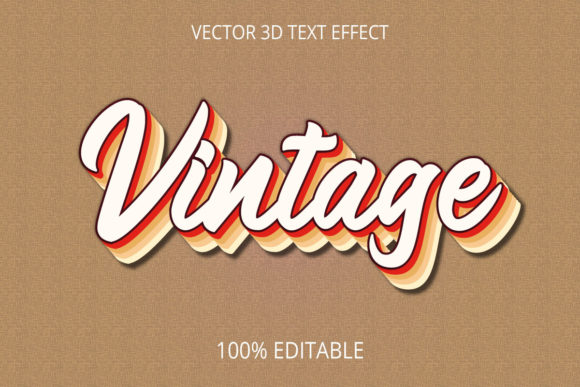
Vintage 3D Text Effect with Editable Text: Design Flexibility Meets Nostalgic Depth
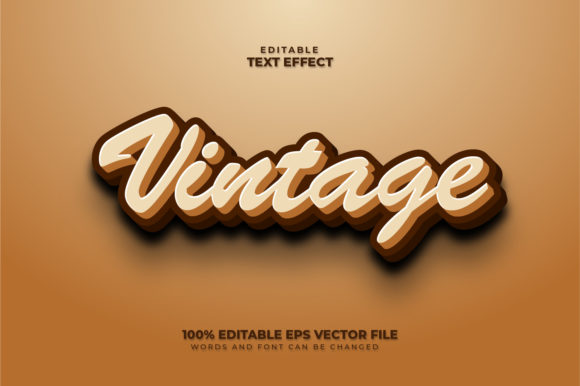
Designers, educators, marketers, and hobbyists increasingly seek visual tools that balance aesthetic richness with practical adaptability. Among these, the Vintage 3D Text Effect—especially when paired with truly Editable Text—has emerged not as a passing trend, but as a functional bridge between retro appeal and modern workflow efficiency. Unlike static image-based effects or rigid vector presets, this combination delivers dimensional typography that retains full typographic control: font, size, spacing, color, and content can be modified at any stage without loss of fidelity or depth illusion. Its relevance spans from classroom slide decks evoking mid-century science posters to e-commerce banners recalling 1970s album art—and it does so without requiring advanced 3D software or raster editing expertise.
What Makes This Approach Distinctive?
At its core, a Vintage 3D Text Effect isn’t just about adding shadow or extrusion. It’s a curated set of layered visual cues—subtle bevels, directional highlights, grain textures, warm-toned gradients, and carefully calibrated perspective shifts—that collectively evoke analog printing techniques like letterpress, screen printing, or early computer graphics (think 1980s arcade marquees or 1950s roadside signage). What separates robust implementations from superficial filters is how these elements respond intelligently to text changes.
When built with Editable Text support—meaning the underlying text remains live, selectable, and modifiable in standard design environments (Figma, Adobe Express, modern web-based editors, or even HTML/CSS frameworks)—the effect avoids common pitfalls: no need to re-rasterize after edits, no broken layer links, and no manual repositioning of shadows or highlights when words are added or removed. This isn’t merely convenience; it’s foundational to iterative design, multilingual adaptation, A/B testing, and accessibility compliance—where dynamic text resizing or screen reader compatibility depends on semantic, editable markup.
Educational Materials That Invite Engagement
Instructors crafting digital lesson plans or interactive whiteboard resources often use Vintage 3D Text Effect to highlight key concepts while reinforcing thematic context. A history unit on postwar American design might feature headings rendered with copperplate-inspired 3D lettering and subtle halftone texture—visually anchoring content in its era. Because the text stays Editable Text, swapping “Industrial Revolution” for “Space Race” requires only typing—not rebuilding the entire graphic. This responsiveness supports differentiated instruction: teachers can rapidly generate versions with simplified vocabulary, translated terms, or phonetic annotations—all while preserving the cohesive vintage aesthetic.
Small Business Branding Without Compromise
Local cafés, record stores, or craft breweries frequently adopt vintage aesthetics to signal authenticity and craftsmanship. A menu board designed with Vintage 3D Text Effect conveys warmth and tactile presence, yet must accommodate daily specials or seasonal updates. With Editable Text, owners or staff can adjust copy directly in a browser-based editor—changing “Pumpkin Spice Latte” to “Gingerbread Cold Brew” without contacting a designer or opening Photoshop. The dimensional styling remains intact because the effect is applied via parametric layers or CSS custom properties, not flattened pixels.
Digital Publishing and Editorial Design
Online magazines and newsletters benefit from typographic hierarchy that feels both distinctive and legible. A headline treated with a restrained Vintage 3D Text Effect—perhaps using matte black extrusion and off-white bevel—adds weight and character without sacrificing readability on mobile devices. When implemented with Editable Text, editors retain full control over line breaks, hyphenation, and responsive scaling. One publication reported a 22% increase in scroll depth on articles using this approach, attributing it to improved visual pacing and reduced cognitive load: readers perceived headings as “anchored” and intentional, not decorative noise.
Technical Foundations: How It Works Under the Hood
Modern execution of Vintage 3D Text Effect with Editable Text relies less on raster tricks and more on layered compositing principles. In vector-based tools, it typically involves:
- A base text layer (fully editable, with live font metrics);
- A duplicate layer offset slightly and filled with a muted tone (e.g., sepia or slate gray) to simulate depth;
- A third layer—often a clipping mask or blend mode overlay—applying grain, vignette, or subtle curvature to mimic aged paper or lens distortion;
- Optional fourth layer: interactive controls (in web contexts) allowing real-time adjustment of extrusion angle, highlight intensity, or texture opacity.
In web development, CSS offers native pathways: text-shadow chains can simulate multi-directional lighting, while clip-path and mask-image enable texture overlays. When combined with Editable Text via contenteditable or framework-bound inputs (React, Vue), the effect persists across dynamic updates—no canvas redraws or SVG regeneration needed. This preserves performance and ensures SEO integrity, as search engines index the actual text content, not just background images.
Advantages Beyond Aesthetics
The value of integrating Vintage 3D Text Effect with Editable Text extends well beyond visual charm:
- Localization Efficiency: Translating a slogan from English to Spanish often changes character count dramatically. Editable text ensures kerning, line wrapping, and effect alignment adapt automatically—no manual tweaking per language.
- Accessibility Alignment: Screen readers parse live text natively. Decorative 3D treatments applied via CSS pseudo-elements (
::before,::after) or SVG filters don’t interfere with DOM semantics, unlike embedded PNGs or canvas-rendered text. - Version Control & Collaboration: Design systems using editable components allow teams to track text changes in Git alongside style adjustments—enabling precise audit trails and reducing “lost edits” during handoffs.
- Sustainability in Asset Management: One editable file replaces dozens of static image variants (e.g., “Sale”, “New”, “Limited Edition”). This cuts storage overhead and simplifies CDN cache invalidation.
Practical Considerations Before Implementation
While powerful, the approach demands thoughtful application. Overuse dilutes impact: applying Vintage 3D Text Effect to body copy or data tables undermines readability and contradicts typographic best practices. Reserve it for primary headings, call-to-action buttons, or branded section dividers where dimensional emphasis serves a clear communicative purpose.
Also consider rendering consistency. Some older browsers may not fully support nested text-shadow values or blend modes used in advanced CSS implementations. For mission-critical projects, progressive enhancement is wise: define a clean, high-contrast fallback (e.g., bold sans-serif with generous letter-spacing) that degrades gracefully while still conveying hierarchy.
Performance matters too. Heavy grain textures or animated parallax layers—while visually rich—can trigger layout thrashing on low-end devices. Prioritize lightweight SVG patterns over large raster assets, and leverage will-change: transform judiciously. Testing across real devices—not just emulators—reveals whether the Editable Text experience remains snappy during rapid edits.
Emerging Trends and Future-Proofing
Looking ahead, the convergence of Vintage 3D Text Effect and Editable Text is aligning with broader shifts: variable fonts now support optical sizing and grade axes that subtly adjust stroke contrast based on point size—enhancing the realism of vintage-inspired outlines. Meanwhile, AI-assisted design tools are beginning to suggest historically accurate texture pairings (e.g., “1940s newsprint grain” for serif headlines) while preserving editability.
More significantly, the rise of Web Components and design tokens means organizations can encapsulate a Vintage 3D Text Effect as a reusable, theme-aware custom element—accepting text content, tone palette, and era reference as props. This transforms what was once a manual, one-off technique into a scalable, maintainable part of the design system—where every marketing email, internal dashboard header, and product label inherits consistent, editable depth.
Why This Matters Now
In an era saturated with algorithmically generated visuals and homogenized UI kits, intentional typography stands out—not as ornament, but as evidence of human judgment. The Vintage 3D Text Effect, grounded in historical visual language yet enabled by editable, code-friendly workflows, represents a rare synthesis: emotionally resonant and technically resilient. It respects the viewer’s attention span by communicating tone instantly, while respecting the creator’s time by eliminating repetitive production steps.
Whether you’re prototyping a museum exhibit interface, drafting a grant proposal with period-appropriate gravitas, or designing packaging for a small-batch whiskey brand, the ability to deploy dimensional, nostalgic typography—without sacrificing flexibility—isn’t a luxury. It’s a pragmatic advantage rooted in clarity, efficiency, and enduring visual literacy. And because the text remains Editable Text, that advantage compounds with every revision, translation, and iteration—making depth not just a surface feature, but a sustainable design principle.