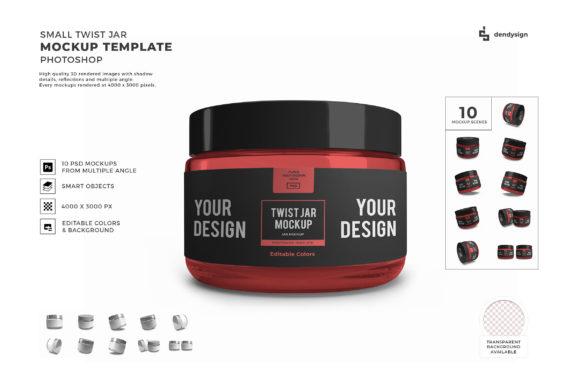
Twist Jar Packaging 3D Mockup Bundle
Imagine presenting your new jam label, organic skincare formula, or small-batch spice blend—not as a flat design on screen, but as a tactile, photorealistic jar resting on a sunlit kitchen counter. That’s the immediate impact of the Twist Jar Packaging 3D Mockup Bundle: a curated set of high-fidelity, fully editable 3D templates built specifically for twist-lid glass or PET jars. No rendering software required. No months-long learning curve. Just drag, drop, and visualize—fast.
What Makes This Bundle More Than Just Another Mockup Pack
This isn’t a collection of static angles or low-res PSDs. Each mockup in the Twist Jar Packaging 3D Mockup Bundle is built with layered smart objects, realistic lighting, subtle surface textures (think condensation on chilled glass or matte frosted finishes), and multiple view options—including front, angled 3/4, overhead, and isolated lid close-ups. You can adjust shadows, background tone, reflection intensity, and even simulate different lighting environments (studio, natural daylight, warm indoor). The result? Presentations that feel grounded, credible, and production-ready—whether you’re pitching to a retailer, updating an e-commerce listing, or sharing a concept with a co-founder.
Creative Possibilities That Start With One Jar
A twist jar is deceptively versatile. Its form bridges function and familiarity—people recognize it instantly, whether holding honey, bath salts, or artisanal hot sauce. That recognition is your creative leverage. Here’s how different users are applying the bundle:
- Product designers use the mockups to test label hierarchy: Does the ingredient list stay legible when wrapped around the curve? Does the logo hold presence at 120px height? They export multiple variants side-by-side—not just for aesthetics, but for usability validation.
- Small-batch food entrepreneurs build cohesive seasonal campaigns. A single jar mockup becomes three variations: spring lavender lemonade (pastel matte label + linen backdrop), summer cherry balsamic (glossy red foil + marble surface), fall spiced pear (kraft paper + wood grain). Consistency emerges from shared structure—not forced uniformity.
- Educators and workshop leaders embed these mockups into student briefs. Instead of asking “design a label,” they say, “Design for this exact jar shape, considering shelf visibility at eye level and secondary display on a café counter.” Constraints spark sharper decisions.
- Freelance marketers prep social-ready assets in minutes: a carousel post showing the same product across four mockup contexts (farmer’s market stall, Instagram flat lay, subscription box unboxing, retail shelf), all using identical branding—no redesign needed.
Adapting to Your Goals—Without Starting From Scratch
The real value isn’t in the jar itself—it’s in how quickly you can make it serve *your* audience and platform. A wellness blogger promoting a magnesium oil spray doesn’t need studio perfection; they’ll choose the soft-shadow, neutral-toned mockup with a blurred herbal background—clean, calm, trustworthy. A TikTok creator launching a hot sauce line might pick the high-contrast version with dramatic side lighting and a charred wood surface, then animate the lid twist in CapCut using the layered PSD files.
For print use, export at 300 DPI with embedded CMYK profiles. For web, save lightweight PNGs with transparent backgrounds—or use the included web-optimized JPEG versions for Shopify banners. If you’re building a brand style guide, pull color values directly from the mockup’s label layer, then document them alongside usage notes: “Primary green appears richer under natural light; reduce saturation by 8% for digital-only applications.”
Keeping It Clear, Consistent, and Human-Centered
Clarity starts with restraint. Don’t overload the jar with seven fonts or competing icons. Use the mockup’s natural curves to guide the eye: place your core message near the shoulder (where the jar widens), keep legal text along the base (where it reads like a footnote), and let negative space breathe around your logo. Test readability by zooming out to 25%—if you can’t identify the product type in under two seconds, simplify.
Consistency comes from systematizing—not standardizing. One client used the same mockup file across six SKUs, changing only the label color, icon, and flavor name—but kept the font weight, spacing, and placement identical. Customers recognized the family at a glance, even without seeing the brand logo first. That kind of visual rhythm builds trust faster than any tagline.
Real Projects, Real Results
A Portland-based tea company reduced packaging revision rounds by 60% after adopting the Twist Jar Packaging 3D Mockup Bundle. Their designer pre-visualized every label variation against actual shelf conditions—lighting, neighboring products, viewing distance—before sending anything to print. No more “It looked bigger on screen.”
Another example: a freelance illustrator created a custom botanical series for a line of cold-pressed tonics. She delivered not just vector labels, but five finished mockups—one per flavor—showing how her hand-drawn illustrations interacted with real-world light, texture, and context. The client approved on first review. The illustrator billed for concept *and* presentation—not just pixels, but perceived value.
Getting Started—Practically, Not Perfectly
You don’t need 3D expertise. You do need intention. Start with one goal: “I want my next product launch to feel tangible to customers before it ships.” Open the mockup. Place your label artwork. Adjust the background until it reflects where your audience will first encounter the product—be it a boutique shelf, a fridge door, or a friend’s kitchen counter. Export two versions: one with subtle shadow (for websites), one with strong directional light (for social ads). Then pause. Ask: Does this look like something someone would reach for? If yes—you’ve already done the hardest part.
The Twist Jar Packaging 3D Mockup Bundle won’t replace thoughtful design. But it removes friction between idea and impression. It turns abstract concepts into shareable, stakeholder-ready moments—without outsourcing realism to a render farm or waiting weeks for a photoshoot. That time saved? Spend it refining your message, testing your audience response, or simply making the next jar better.