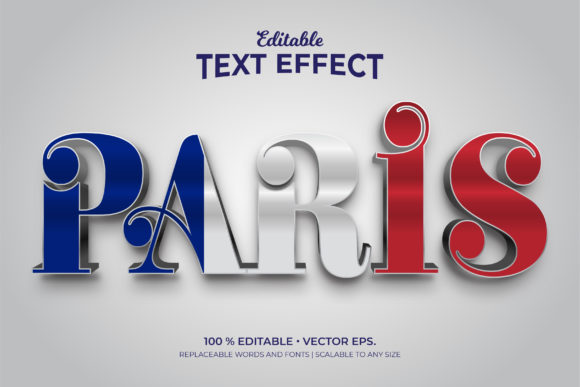
Paris 3D Editable Text Effects Templates: When Realistic Depth Meets Design Flexibility
Paris 3D Editable Text Effects Templates refer to a specialized category of design assets—typically delivered as layered PSD, Figma, or After Effects files—that simulate the visual language of Parisian typography: elegant curves, subtle metallic sheens, soft ambient shadows, and architectural depth inspired by signage, café marquees, and historic façades. Unlike generic 3D text generators or one-click online tools, these templates are built for hands-on customization: font replacement, color adjustment, lighting repositioning, material swapping (e.g., brushed brass to matte stone), and perspective fine-tuning—all without requiring 3D modeling expertise.
What Sets Paris 3D Editable Text Effects Templates Apart
Their distinction lies in intentional stylistic cohesion and editable realism. While many “3D text” resources prioritize dramatic extrusion or glossy neon effects, Paris 3D Editable Text Effects Templates emphasize restrained dimensionality—think the gentle bevel on a bistro menu header or the weathered bronze tone of a street plaque—not cartoonish spikes or over-saturated gradients. Each template is pre-structured with non-destructive layers: smart objects for text, layer styles for depth cues, and adjustment layers for ambient light control. This means users can change the word “Boulangerie” to “Atelier,” shift its hue to match a brand palette, and tweak shadow softness to suit print versus web output—all within familiar 2D editing environments.
This approach bridges a practical gap: designers who need evocative, location-infused typography but lack time—or licensing rights—to commission custom 3D renders or model from scratch. It also avoids the rigidity of static PNG overlays, where resizing distorts proportions or altering color requires tedious masking.
How They Compare With Other Text Effect Options
Understanding where Paris 3D Editable Text Effects Templates fit requires comparing them across three common alternatives: browser-based 3D text generators, vector-based 3D extensions (like Illustrator’s 3D Extrude & Bevel), and fully rendered 3D assets (e.g., Blender exports).
- Browser-based generators offer speed and zero setup—but produce flattened PNGs or SVGs with no editable depth parameters. You can’t adjust the angle of incident light or swap materials mid-project. They’re useful for quick social media banners but fall short when consistency across a multi-page brochure or responsive website matters.
- Vector 3D tools give precise control over extrusion depth, surface rotation, and lighting—but require manual rebuilding for each new word or layout change. Achieving the nuanced patina or subtle gradient falloff typical of Parisian signage demands significant layering and blending work, often resulting in large, unwieldy files.
- Fully rendered 3D assets deliver photorealism but lock in perspective, lighting, and resolution. Editing means returning to the original 3D software, re-rendering, and re-exporting—adding friction for iterative client feedback or A/B testing headlines.
Paris 3D Editable Text Effects Templates sit between these extremes: they retain the fidelity and mood of high-end 3D rendering while preserving the workflow efficiency of layered 2D design files. Their strength isn’t raw technical power—it’s contextual appropriateness and reuse velocity.
Real-World Fit: Where These Templates Deliver Value
They shine most clearly in projects where atmosphere and authenticity matter more than absolute geometric precision. Consider a boutique travel agency launching a “Paris Literary Walks” campaign: using a Paris 3D Editable Text Effects Template for the headline “Les Mots de Paris” allows consistent styling across Instagram carousels, email headers, and printed itinerary covers—each version adjusting only the text and background, not rebuilding the entire effect.
Similarly, a French-language podcast branding itself around “urban elegance and quiet storytelling” might use the same template across logo variants, episode thumbnails, and merch mockups. The editable nature means the team can test variations—softening the metallic finish for a winter series, deepening the drop shadow for dark-mode UI—without sourcing new assets each time.
These templates also support localization efficiently. A single base file can generate “Café”, “Librairie”, and “Galerie” versions with matching depth cues and texture logic—something difficult to replicate manually at scale without visual drift.
Limitations and Decision Factors
They aren’t universal solutions. Because they rely on raster-based layer effects (especially in PSD formats), extreme scaling—such as blowing up a 1200px-wide template to billboard size—can reveal pixelation or banding in gradients. For large-format print, vector alternatives or custom 3D renders remain safer.
Also, true perspective warping (e.g., wrapping text convincingly around a curved café awning) isn’t built-in. While some templates include basic warp layers, complex environmental mapping requires additional compositing skill. Users expecting plug-and-play distortion should plan for supplementary work—or consider motion graphics tools instead.
Licensing is another practical consideration. Most Paris 3D Editable Text Effects Templates are sold under standard commercial licenses, permitting use in client work—but prohibit redistribution of the template file itself or resale as part of a design bundle. Always verify license scope before committing to a project with strict IP requirements.
When to Choose—And When to Look Elsewhere
Choose Paris 3D Editable Text Effects Templates if:
- You’re working within Adobe Photoshop, Figma, or After Effects—and want depth that feels grounded, not gimmicky;
- Your project benefits from strong geographic or cultural resonance (e.g., hospitality branding, cultural events, Francophone education);
- You need multiple text variations (headlines, subheads, callouts) with visual continuity across formats;
- Timeline or budget constraints rule out custom 3D modeling or extended experimentation with vector tools.
Consider alternatives if:
- Your output demands infinite scalability (e.g., variable signage systems or generative web typography);
- You require animated text (e.g., rotating 3D letters or morphing transitions)—static templates won’t suffice without additional motion work;
- Your aesthetic leans toward industrial, futuristic, or minimalist rather than romantic, historic, or artisanal—the Paris influence is intentional and stylistically specific;
- You’re building a design system where every component must be fully parametric and code-driven (e.g., CSS 3D transforms or Three.js integration).
Practical Evaluation Tips
Before downloading or purchasing, inspect sample files closely. Look for:
- Layer organization: Are text layers clearly labeled and grouped? Are smart objects used consistently for editable content?
- Lighting flexibility: Can you adjust highlight position or shadow intensity via layer opacity or blend modes—or is it baked in?
- Material variety: Does the package include alternate surface options (e.g., chalkboard, aged plaster, wrought iron) or just one default look?
- Documentation: Even brief notes on how to replace fonts or adjust perspective save hours of reverse-engineering.
Also, test responsiveness: paste your intended headline into the template and check whether kerning, line breaks, and spacing hold up at your target sizes. Some templates handle single words beautifully but struggle with longer phrases due to fixed shadow offsets or rigid bevel settings.
Ultimately, Paris 3D Editable Text Effects Templates serve a distinct niche—not as all-purpose 3D tools, but as curated, context-aware starting points for designers who value both craft and efficiency. They reward thoughtful selection over broad application, and their usefulness grows with familiarity: the more you understand their structure, the more adaptable they become.