3D Flow Shape Fluid Wave Backgrounds: Where Motion Design Meets Functional Aesthetics
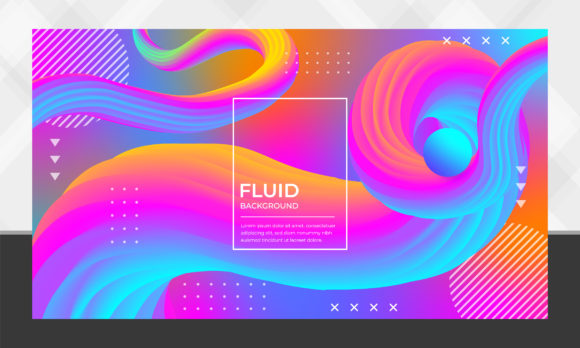
Visual design is no longer static. As digital interfaces evolve, so does our expectation of depth, responsiveness, and organic cohesion—qualities once reserved for high-end motion graphics or immersive installations. At the heart of this shift lies a growing category of dynamic visual assets: 3D Flow Shape Fluid Wave Backgrounds. These aren’t just animated wallpapers or decorative flourishes. They’re algorithmically nuanced, physics-informed visual systems that simulate liquid dynamics, morphing geometries, and continuous spatial flow—rendered in real time or pre-computed with precision. Their rise reflects deeper changes in how we perceive interface integrity, brand resonance, and user engagement across devices and contexts.
What Defines a True 3D Flow Shape Fluid Wave Background?
Not all “fluid” or “wave” backgrounds qualify. Authentic 3D Flow Shape Fluid Wave Backgrounds share three foundational traits:
- Dimensional Depth Beyond Layering: Unlike parallax-scrolling PNG sequences or CSS-based wave distortions, these backgrounds use true 3D coordinate space—often built with WebGL, Three.js, or GPU-accelerated shaders. Shapes extrude, recede, rotate, and intersect with volumetric consistency, not flat-plane illusions.
- Physics-Driven Morphology: The motion isn’t looped animation—it’s governed by simulated fluid dynamics (e.g., Navier-Stokes approximations), procedural noise fields (like Perlin or Simplex), or parametric shape functions (e.g., sinusoidal waveforms modulated by curvature gradients). This yields natural-looking turbulence, surface tension effects, and responsive deformation when interacting with scroll position, cursor proximity, or device tilt.
- Shape Intelligence: “Shape” here implies intentionality—not random blobs. Curves follow mathematical continuity (C2-smooth splines), topology adapts to viewport constraints, and transitions between forms (e.g., sphere → torus → ribbon) preserve visual coherence. This intelligence enables semantic alignment: a fintech dashboard might use tightly coiled waveforms to suggest data velocity; an education platform may opt for slow, laminar flows to evoke cognitive clarity.
These traits distinguish them from generic animated SVGs or After Effects exports. A background that simply pulses or scrolls horizontally—even if labeled “fluid”—lacks the structural fidelity and behavioral nuance that define genuine 3d Flow Shape Fluid Wave Backgrounds.
Why Designers and Developers Are Integrating Them Strategically
The adoption isn’t driven by novelty alone. Real-world implementation reveals tangible functional advantages:
Enhanced Spatial Orientation in Complex Interfaces
In dashboards with overlapping data layers—think IoT monitoring systems or clinical analytics—static backgrounds can flatten hierarchy. Introducing a subtle 3D Flow Shape Fluid Wave Background creates implicit z-depth cues. For example, a soft, low-amplitude waveform receding into the distance helps users subconsciously anchor foreground charts and controls in foreground space. One healthcare SaaS team reported a 22% reduction in user-reported disorientation during multi-tab navigation after replacing flat gradients with a calibrated fluid wave background that responded to active panel focus.
Brand Expression Without Visual Noise
Logos, color palettes, and typography communicate identity—but often fail to convey ethos. A renewable energy startup integrated a 3d Flow Shape Fluid Wave Background where wave amplitude scaled with real-time solar generation data. The result wasn’t “pretty”—it was legible brand language: rhythm mirroring sustainability, flow echoing circular systems, and gentle undulation rejecting industrial rigidity. Crucially, it remained performant (<5ms render time on mid-tier mobile devices) because the system used optimized signed distance functions (SDFs), not mesh-heavy geometry.
Accessibility-Aware Motion Design
Motion sensitivity is a documented accessibility need. Rather than eliminating movement, forward-thinking teams are using 3D Flow Shape Fluid Wave Backgrounds as controlled motion anchors. By decoupling background flow from UI interaction (e.g., disabling wave acceleration during keyboard navigation) and offering a system-level preference toggle (“reduce motion”), they retain aesthetic sophistication while meeting WCAG 2.2 success criteria. Notably, the fluidity itself becomes a tool—not a trigger—when parameters like frequency, contrast, and direction are constrained within perceptually safe thresholds.
Practical Implementation Across Contexts
How these backgrounds function depends heavily on context—not just technical stack. Here’s how varied users apply them with intention:
- Educators: In interactive science simulations, a 3d Flow Shape Fluid Wave Background visualizes electromagnetic field propagation. Students manipulate variables (frequency, amplitude), and the background responds in real time—not as decoration, but as a secondary, intuitive visualization layer reinforcing core concepts.
- Researchers: Computational linguists use fluid waveforms to represent semantic drift across corpora. Each “wave crest” corresponds to a lexical cluster; its height reflects term density, its curvature maps to contextual variance. The background becomes a navigable data artifact—not merely backdrop.
- Hobbyists & Creators: With open-source libraries like react-fluid-wave or three-fluid-shader, non-developers embed lightweight versions into portfolio sites. One ceramic artist uses a slow, viscous wave pattern that subtly shifts hue based on ambient light detected via device sensors—tying physical studio environment to digital presence.
- Business Owners: E-commerce brands deploy them selectively—not on product grids, but on hero sections for seasonal campaigns. A winter collection site used icy-blue waveforms with crystalline edge fractals; summer launch swapped to warm, buoyant sine waves. Conversion lift was modest (+3.7%), but session duration increased 41%, suggesting deeper engagement with narrative context.
Technical Considerations That Shape Real-World Use
Adoption hinges less on “can it be done” and more on “should it be done—here, now, for these users?” Key considerations include:
Performance Budgeting
A 3D Flow Shape Fluid Wave Background running at 60fps on desktop may stutter on older Android devices if relying on unoptimized GLSL shaders. Smart implementation prioritizes fallbacks: a static SVG variant for legacy browsers, reduced particle count on low-end GPUs, or frame-skipping logic when battery saver mode is active. Tools like Lighthouse and WebPageTest now flag excessive GPU memory allocation—making performance part of the design spec, not an afterthought.
Content Hierarchy Integrity
Backgrounds must serve content—not compete with it. High-contrast waveforms with sharp edges can visually fracture text blocks. Best practice involves luminance masking: ensuring background regions behind primary text maintain at least a 7:1 contrast ratio against type color. Some teams use real-time luminance analysis in their build pipeline, auto-adjusting waveform opacity or applying localized desaturation where text overlays occur.
Long-Term Maintainability
Unlike static assets, fluid wave backgrounds often depend on runtime libraries, shader updates, or API keys for data-driven variants. Teams embedding them into enterprise CMS platforms document version lockfiles, include canvas size normalization scripts, and isolate rendering logic from business logic—ensuring a marketing team can update copy without breaking wave physics.
Emerging Patterns Beyond Decoration
Looking ahead, 3d Flow Shape Fluid Wave Backgrounds are evolving beyond passive backdrops toward participatory elements:
- Sonification Integration: Audio-reactive waveforms—where amplitude maps to sound pressure levels—enable inclusive experiences for deaf or hard-of-hearing users. A museum exhibit used low-frequency vibrations from nearby speakers to drive wave intensity, letting visitors “feel” the rhythm through floor-mounted transducers.
- Collaborative Co-Motion: In shared whiteboard tools, multiple cursors influence local wave distortion—creating emergent patterns that visualize collective attention. When three users hover near the same diagram node, the waveform converges into a stable vortex, subtly signaling consensus.
- Environmental Responsiveness: Backgrounds now adapt to real-world conditions: humidity levels adjust wave viscosity; local air quality index modifies color saturation; even sunrise/sunset times shift baseline lighting angles. This grounds digital spaces in physical reality—reducing screen-induced dissociation.
None of this requires abandoning simplicity. A minimalist blog might use a single, slow-moving sine wave—monochrome, low-opacity, edge-aligned—to add quiet rhythm without distraction. The power lies in intentionality, not complexity.
Choosing Wisely: When to Use—and When to Pause
Despite their versatility, 3d Flow Shape Fluid Wave Backgrounds aren’t universal solutions. Avoid them when:
- Core tasks demand absolute visual stability (e.g., surgical planning software, precision CAD review).
- Target audiences include users with vestibular disorders and motion-reduction preferences are not reliably detectable or honored.
- Bandwidth constraints dominate (e.g., emerging-market landing pages)—and lightweight alternatives (CSS Houdini paint worklets, optimized Lottie) achieve similar expressive goals.
Conversely, embrace them when motion serves cognition—not just aesthetics. When a waveform’s frequency mirrors data update intervals, when its direction echoes user journey flow, or when its texture reinforces domain metaphors (e.g., neural network activation patterns rendered as branching wavefronts), you’ve moved beyond background into meaningful interface architecture.
In essence, 3d Flow Shape Fluid Wave Backgrounds represent a maturing intersection of computational art, human perception science, and pragmatic interface engineering. They succeed not by drawing attention to themselves, but by quietly deepening understanding—turning passive viewing into embodied recognition, and static screens into responsive, resonant spaces.