3D Cherry SVG Cut File: What You Need to Know Before Cutting, Designing, or Selling
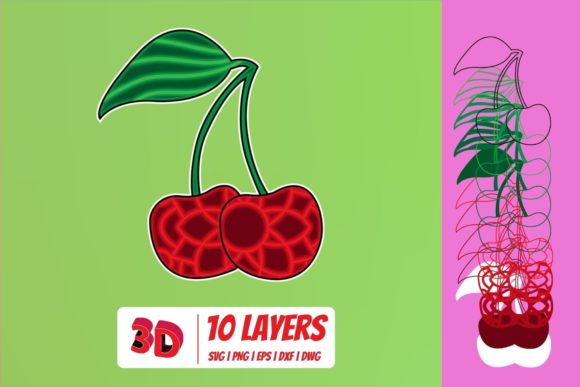
If you've seen a vibrant, layered cherry design pop off a tumbler, greeting card, or wall decal—and wondered how it was made—you're likely looking at a 3D Cherry SVG Cut File. Unlike flat, single-layer graphics, these files contain multiple vector layers (often 3–5) carefully aligned to simulate depth—shiny highlights, subtle shadows, and dimensional fruit texture—all built for cutting machines like Cricut, Silhouette, or Brother ScanNCut. They’re popular with crafters launching Etsy shops, educators creating tactile learning tools, and small businesses personalizing retail products. But not all 3D Cherry SVG Cut Files deliver what they promise—and many users only discover the mismatch after spending time, material, or money.
Assuming “3D” Means Automatic Depth—It Doesn’t
Here’s the most common misunderstanding: thinking that “3D” in the file name guarantees ready-to-cut dimensionality. In reality, 3D Cherry SVG Cut File refers to the layered design intent—not plug-and-play assembly. Many free or low-cost versions include overlapping shapes but lack proper registration marks, consistent stroke weights, or grouped layers. That means when you import them into Design Space or Silhouette Studio, layers may shift, cut lines may double up, or shadow elements may vanish during auto-trace. One educator reported wasting two hours—and six sheets of vinyl—trying to align a mislabeled “3D” file before realizing its shadow layer had zero cut line assigned.
Better approach: Always open the file in your design software *before* loading material. Check that each layer has a visible stroke (not just fill), is properly named (e.g., “Cherry-Base,” “Cherry-Highlight”), and sits on its own locked layer. If layers are merged or ungrouped by default, assume extra prep work is needed—not a flaw in your machine.
Overlooking Compatibility and Software Limits
A 3D Cherry SVG Cut File might look flawless in Illustrator—but behave unpredictably in Cricut Design Space. Why? Because SVG is a universal format, but how each platform interprets embedded paths, compound shapes, or transparency varies. Some files use advanced vector features (like clipping masks or gradient meshes) that Silhouette Studio supports but Cricut doesn’t render correctly. Others embed raster images (JPEGs or PNGs) inside the SVG—a red flag. Those won’t cut; they’ll only print or cause errors.
Also watch for outdated file structures. Older 3D Cherry SVG Cut Files sometimes rely on legacy grouping methods that newer software treats as flattened objects. The result? A cherry that cuts as one solid shape instead of five distinct layers.
What to check before downloading or buying:
- Does the product page specify tested compatibility (e.g., “Cricut Explore Air 2 & Maker 3 verified”)?
- Are preview images showing actual software screenshots—not just mockups?
- Is the file delivered as a clean .svg (not .zip containing .png + instructions)? If it’s bundled with PDF guides or layered PNGs, treat it as supplemental—not core.
Skipping Material and Scale Testing
Even a perfectly structured 3D Cherry SVG Cut File can underperform if used without context. A design scaled to 4 inches tall may look lush on a tote bag—but lose definition when shrunk to 1.5 inches for a keychain. Likewise, glossy vinyl handles layer adhesion differently than heat-transfer vinyl (HTV) or cardstock. Without testing, users often discover too late that highlight layers peel off after washing, or shadow layers don’t adhere evenly due to inconsistent pressure settings.
One small-batch candle maker learned this the hard way: she applied a 3D Cherry SVG Cut File to 200 jars using standard pressure, only to find the topmost “shine” layer lifted on 30% of units within a week. The fix? Reducing cut depth by 0.1mm on her Cricut Maker and using a brayer with light, circular motion—not firm strokes—when applying the thinnest layer.
Practical tip: Always run a test cut on scrap material at your intended size. Use a ruler to verify layer alignment *after* weeding—not just before. And if your project involves heat application (like HTV), confirm whether the file includes mirror-flip guidance. Not all 3D Cherry SVG Cut Files do—even when required.
Misreading Licensing—and Underestimating Usage Rights
Many creators assume “personal use only” means they can’t share photos of their finished projects online. That’s usually false—most reputable sellers allow social sharing with credit. But where confusion causes real risk is in commercial use. A freelance designer bought a budget pack of 50 SVGs labeled “commercial use,” only to find the license excluded resale of *digital files*—meaning she couldn’t include the 3D Cherry SVG Cut File in a client’s brand kit. Worse, some licenses restrict use on POD (print-on-demand) platforms like Redbubble or Printful unless an extended license is purchased.
Before you buy or download:
- Read the license summary—not just the headline.
- Check if “commercial use” includes sub-licensing, digital delivery, or physical product resale.
- Look for clarity on attribution requirements (e.g., “link back in bio” vs. “credit in caption”).
Underestimating Time Investment for Realistic Results
There’s no shortcut to convincing dimension. Even with a well-built 3D Cherry SVG Cut File, achieving depth requires thoughtful layer sequencing, precise weeding order, and intentional placement pressure. Rushing leads to misaligned highlights or air bubbles between layers—especially on curved surfaces like mugs or bottles.
A better path isn’t more complex software—it’s smarter workflow. Start with the base layer, let adhesive set for 30 seconds, then add mid-tone, then highlight. Use tweezers with fine tips—not fingers—for tight corners. And store unused layers face-down on a silicone mat to prevent dust buildup or static cling.
Remember: the goal isn’t speed—it’s consistency. One small business owner doubled her repeat customer rate after switching from rushing full batches to assembling cherries in sets of five, checking alignment under natural light before moving on.
Final Thought: Quality Starts With Clarity
A great 3D Cherry SVG Cut File doesn’t shout “3D!” in bold font—it shows intention in every path, naming convention, and tested output. It respects your time by including clear layer labels, compatible formats, and realistic usage notes. When evaluating options, prioritize sellers who show process videos over stock photos, list version history, and answer technical questions publicly. That transparency—not flashy descriptions—is your best indicator of reliability.
You don’t need the most expensive file. You need the one that works—predictably, cleanly, and without surprise revisions. Start small, test deliberately, and build confidence layer by layer—just like the design itself.